Sight-Free Seeing
By Bruno FazzolariThere’s a certain critical laziness where you don’t have to engage with the object, you can just respond verbally to other verbal notions, so you don't have to engage with the instability of perception.
More »
February 11, 2010. This is Art Practical’s first thematic issue. Corresponding with the opening of the Luc Tuymans mid-career retrospective at SFMOMA, The Painting Issue offers multiple perspectives on this influential artist’s practice. Our writers go well beyond the questions of history and photographic representation that Tuymans’ work usually provoke, however. Looking across a diverse range of painters, both local and international, they reflect on personal iconography, abstraction, painting’s physical qualities, and the importance and pleasure of seeing. Enjoy! – PM Next AP Issue: February 25, 2010
Image: Luc Tuymans, Schwarzheide, 1986; oil on canvas; 23 5/8 x 27 5/8 in. (60 x 69.9 cm). Private collection; © Luc Tuymans. Photo: courtesy David Zwirner, New York.
There’s a certain critical laziness where you don’t have to engage with the object, you can just respond verbally to other verbal notions, so you don't have to engage with the instability of perception.
More »
With a grin, Tuymans beckoned us into the first of the large, spacious rooms: "Now we move into the light!" It is unclear whether he was referring to the room with its bright, high ceilings, or to the paintings themselves. Nonetheless, many of the works in the large galleries do possess a glowing, internal luminosity that his earlier works don’t.
More » By Renny Pritikin
 By Leigh Markopoulos
 By Mary Anne Kluth
 By Christine Kesler
 By Elizabeth Johnson
 By Randall Miller
August 19, 2010. We’ve reached the end of our first issue year, during which Art Practical went from being an enthusiastically supported idea to an established critical forum for Bay Area visual arts. To mark the occasion, Art Practical’s editors reflect on the wealth of writing that’s appeared on the site, while some of our writers highlight their favorite exhibitions, events, and people from the past twelve months. They had free range to choose their themes; their selections—both…
July 29, 2010. Today is Art Practical’s nine-month anniversary—a gestational period, if you will. Although technically we were birthed in late October, the reflection and analysis in which the editorial team, writers, and readers have been engaged since then have felt very much like incubation at times. The conversations around what the site can and needs to do have adopted a rhythm familiar to new initiatives in the Bay Area, a combination of welcomed embrace, enthusiastic participation, and finely tuned critique. Moving…
July 15, 2010. We are separate yet connected. The idea is no less true for its prevalence, and Issue 19 is proof. Collaborations—among reviewers, curators, galleries, and artists―abound. Christine Wong Yap and Lea Feinstein team up to review “They Knew What They Wanted,” a group show with four curators spanning four separate galleries, while AP partners with Daily Serving to present a review of “They Have Not the Art to Argue with Pictures.” Hou Hanru interviews two artists who rely…
July 1, 2010. In this issue, we include interviews with Natasha Wheat about social practice and photographer Marion Gray about documenting significant moments of Performance Art. Through these conversations, art can be understood as a negotiated social encounter in space and time. And in the reviews, tenuousness, arbitration, and ambivalence are all givens in encounters with contemporary art. But can things that are binding be teased out from temporary situations and subjective perspectives? Or what does it mean to rely on the imagined,…
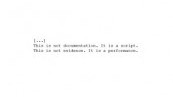
June 28, 2010. As a bonus to Issue 17, we'd like to present this excerpt from a work in progress by artist Matthew Rana, entitled Script for a Dead Comedian (1962-2010). As part of his ongoing investigation into the relationship between art and law, Rana examined suppression and representation of the truth in his article "The Law, Onstage: The People vs. Lenny Bruce," focusing on the comedian's performance of the law following his obscenity trials in the early 1960s. Here, Rana combines the comedian's…
The idea that an artist needs to be highly introspective is a prevailing one, and it butts up more or less against the perceived mandate for one to effect wide-ranging change. An artist stakes territory somewhere along the spectrum of poet, seer, truth-seeker, and activist. In this issue, our writers offer commentary about each of those positions, as well as how they are performed for, and perceived by, audiences.
June 3, 2010. One of the most remarkable things about Louise Bourgeois’ career was neither its length nor late-bloom—although both are quite remarkable—but her capacity to remain current. Each new body of work added perspective to our understanding of her as an artist and to the dialogue around contemporary art. That fact gains significance when we contemplate the ever-diminishing lifespan for an object’s relevance. Wunderkammers and wonder boxes are esoteric frameworks for perceiving the world; taste…
May 20, 2010. Uneasy bedfellows permeate Issue 15: optimism and folly, community and exclusion, the representation and construction of images. Not necessarily opposites—more like wary co-dependents—these qualities and attributes often underlie the contradictory impulses of the Bay Area visual arts community. The perpetual struggle for funding hardly dampens the outpouring of new initiatives, and the critical and philosophical engagement with social practices doesn’t undermine the desire to engage with the market. Aspiration, risk, failure, and reconciliation are all of…
May 6, 2010. “It is not yet the end of May for us,” Jeffrey Stuker writes in his essay on Michael Asher, recalling the Paris strikes of 1968, but also asserting that we cannot swear off the potential for rupture and collapse of law, a law always on the verge of martial law. Those words echo across Matthew Rana’s examination of regulations that deny to some the very rights they grant to others. And as these writers (and the artist who are…
April 22, 2010. Art Practical not only strives to produce engaging and thought-provoking essays, but to encourage creative efforts, and think about what forms critical dialogue might take. We hope to enable emerging writers to refine their practice amidst those already renowned for their critical insight. In this issue, contributor Lea Feinstein reflects on her writing practice—the questions she asks in coming to an understanding of a work of art—as a prelude to our two-part Critical Sources workshop, co-hosted by The…
April 8, 2010. The ongoing economic crisis looms over Issue 12. In reviewing “Plastic Life,” Laura Cassidy notes the emphasis on adaptability, the human condition that foments creative responses to changing environments. In contrast, other reviews expose the anxiety and resistance that accompany adaptation. Randall Miller outlines the perpetually tenuous state of the middle class articulated by Rich Bott’s work, while Brian Andrews homes in on the false promises proffered by American suburbia in “Siege.” Concurrently, though, Genevieve Quick…
March 24, 2010. In her review of Recipes for an Encounter, Dena Beard notes the “inherent discord of art activism” in describing the various artist interventions the book contains. Discord is a noticeable feature of artistic practice in the Bay Area—the idea that social fabric can and needs to be rent apart. This issue makes note of some disruptions: the absurdities of daily life wryly documented by Mads Lynnerup; the large-scale disparities between life and law, explored in conversation…
March 11, 2010. On Monday, I stood dazed at the top of the ramp of the Guggenheim Museum in New York, left there by the final of four companions in a conversation that began when a young girl asked me what my idea of progress was. The museum was devoid of work except for these conversations with visitors. Orchestrated by the artist Tino Sehgal, the experience was part social ritual, part entrancing performance. I thought of both Anthony Marcellini’s and Mia Stageberg…
February 25, 2010. We seem to be in a particularly introspective moment, if this issue is any indication. The confluence of SF anniversary exhibitions—the Arts Commission Gallery, MOMA, and Camerawork—are certainly one impetus, and multiple perspectives on the last two are offered here. Another catalyst was Renny Pritikin's recent Open Space blog entry, from which this issue's title derives. It generated a barrage of comments about the concerns artists face living and working here, as well as their motivations and…
January 28, 2010. In Issue 7, we debut our partnership with the national, weekly contemporary art podcast, Bad At Sports. Founded in 2005, the series focuses on presenting the practices of artists and other cultural producers through an online audio format. Collaborative episodes will appear monthly on both sites. For this issue, Scott Oliver sits down with J. Morgan Puett to discuss Mildred's Lane and the revolutionary politics of garments. An abridged version of their conversation appears here; the audio can be heard starting Sunday, January 31 at http:/…
Happy New Year! In our first issue for 2010, Allison Smith discusses her projects for the anniversary celebration at SFMOMA and her storefront studio SMITHS, while Matthew Rana explores artistic practices that expand notions of political agency. Collectively, they offer nuanced perspectives on what Smith describes as “tactile entry points” for encounter. Rachel Adams takes us back to New York for a look at the Orozco show at MoMA, while Jessica Brier, Brady Welch, Carol Anne McChrystal, and Keturah Cummings share their views…
Issue 5 features Terri Cohn’s 2002 interview with David Ireland, whose works and collaborative initiatives did much to shape the Bay Area visual arts community. And while Aimee Le Duc notes that the question of how to sustain that community seems more urgent then ever, she also points to the currency that collective endeavors continue to possess. In addition to the Reviews, this issue includes an expanded section of Shotguns, and we go further afield, as Renny Pritikin reports from New York.…
What are the places for art? In Issue 4, Christian L. Frock considers alternatives to institutional endeavors in contemporary art while the founding and current Directors of the UC BAM/PFA reflect on the history and future of the museum and its building. Stephanie Baker reviews Jordan Essoe’s “Living Room,” while Zachary Royer Scholz looks at the collaborative venture between Hallway Projects and 667 Shotwell. Additional reviews by Brian Andrews, Leigh Marcopoulos, Randall Miller, and Genevieve Quick, as well as…
Issue 3 ventures outside of the Bay Area to take a look at the Eleventh International Istanbul Biennial. Anthony Marcellini, currently on fellowship in Gothenburg, Sweden, critiques its curatorial strategy while Patricia Maloney recounts her recent conversation with the curators. Several of the reviews take into consideration how value is attributed, whether in the use of appropriated images and recycled material, or in the juxtaposition of anonymously crafted and artist-designed multiples. Additional pieces examine intertwined narratives—personal and historical, cultural and folkloric—Martha…
Home, balance, and noise figure prominently in Issue 2. In their Features, the vulnerability of tenancy underlies Adrienne Skye Roberts and Megan Wilson’s reflections on transforming their private residences into exhibition spaces. Renny Pritikin looks at the end of SoEx's nomadic ways with the opening of its new home. Bruno Fazzolari, Carol Anne McChrystal, and Zachary Royer Scholz discuss radically different material strategies for creating balance and flux. And Brady Welch and Jess Brier examine two of the more dissonant avant-garde endeavors of…
Welcome to the debut of Art Practical! We are thrilled to introduce this online art journal to you, and with it, expanded possibilities for critical dialogue in the Bay Area. Alongside reviews and an essay from Talking Cure, you’ll find a selection of events (both those coming up and those you shouldn’t miss) shared from Happenstand. This launch reflects the result of months of conversation with and efforts from a fantastic team of…