
Shotgun Review
A New American Picture
May 31, 2011In Detroit, a blurry dancing figure is frozen mid-jig in front of a collision repair shop that also sells cars. The sun sets behind a dilapidated house in West Helena, where large puddles and an upended child’s truck litter the side yard. A pit bull under stark light in Dallas suspiciously eyes the viewer as he crouches between a telephone pole and a severed tree branch.
Doug Rickard’s A New American Picture, which is rooted in traditional documentary photography, provides voyeuristic access to often overlooked lives. Like Walker Evans and Robert Frank, Rickard challenges viewers to be thoughtful readers of the stories of a widening social divide and its ensuing devastation, inviting them to contemplate life in those cities hit hardest by America’s most recent economic meltdown. However, his use of twenty-first-century technological artifacts as both source material and methodology take the documentary tradition to the next level.
Google’s cameras rove the streets of America like robotic paparazzi, snatching unauthorized panoramas of places and the people who live there, posting them online to be accessed by anyone able to type a street address. These images are Rickard’s raw material. He pores through them to select his frame, re-photographing those selections on his computer monitor and printing them large for display in galleries.
It is understood that the gallery audience is primarily middle to upper class and that this is far from his subject’s vantage point. Re-photographing further removes the image from its original context; the gap between viewer and subject—the voyeuristic divide—is widened. Moreover, this process
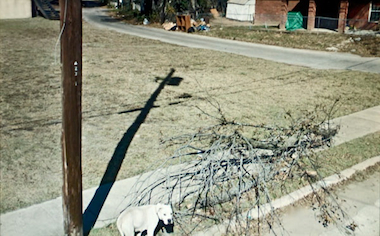
#32.700542, Dallas, TX 2009, 2010; archival pigment print; 16 x 25 in. Courtesy of the Artist and Stephen Wirtz Gallery, San Francisco.
drastically degrades the already low-resolution digital image. Identities hastily blurred by Google are now veritable silhouettes. In #120.074209, Fresno, CA 2009 (2010), a man sits in a wheelchair in front of his house, a pickup truck parked behind him on the dusty lot. He directly addresses the camera, yet his face has been blotted out and his body is relatively formless. Without facial features, it is impossible to discern his emotions. It appears he has lost a leg, the reason for the wheelchair, but it is difficult to be certain since his limbs are poorly defined.
Even though this perceived distance permits viewers to enter the work, there is also a vertiginous, surreal, haunting feeling. The final printed photographs are hyper-exposed, with melting pools of vivid color. Standing in front of them in the gallery, it is striking how deserted the scenes feel. People are isolated and frozen in time like the victims of Pompeii, resulting in photographs with a post-apocalyptic quality that alerts viewers to their own demise.
A New American Picture is on view at Stephen Wirtz Gallery, in San Francisco, through June 11, 2011.
Melony Bravmann is a visual artist and art writer based in the Bay Area. The goal of her commentary and analysis is to inform viewers and instill a passion for contemporary art. She holds a BFA and an MFA from CCA.