
Shotgun Review
Anri Sala at the 29th São Paolo Biennial and Inhotim
November 28, 2010One way to elude the unceasing masses of school groups that pulsed through the 29th São Paolo Biennial was to duck into a screening room, of which there were many. Anri Sala’s Le Clash (2010) offered my favorite reprieve. An antidote to the anxiety of navigating the Biennial, Sala transforms the punk-rock angst of the Clash’s anthem “Should I Stay or Should I Go?” into a contemplative, if ominous, lullaby. The piece weaves two performances of the song together, alternating between a wandering, bewildered-looking man—slowly playing a handheld music box that emits the refrain of the song—and another man and woman pushing a music box on a cart. They compete with yet complement each other, as if in a round. The man and the couple each arrive, though not simultaneously, at a boarded-up concert venue where the Clash played while on tour in France during the early 1980s. Fittingly, the music stops here.
An exploration of the legacies of now-defunct sites of cultural resistance and production, the work also draws a parallel between the uncertain future of the abandoned concert venue and the titular lyrics, which portend the end of a relationship between the song’s writer, Mick Jones, and the musician Ellen Foley. Just outside the screening room, one finds the metal comb of a music box affixed to a window. Like much of the work at the Biennial, this object is guarded, which takes away from the sense of quiet, self-discovery that makes Le Clash sort of magical. Placing an ear to the window frame while
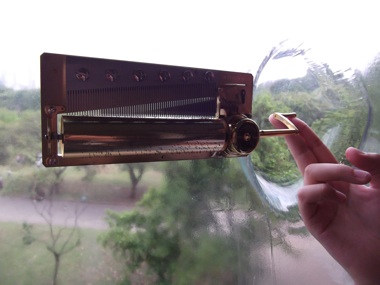
Anri Sala. Le Clash, 2010; music box comb, installation view. Courtesy of the 29th São Paulo Biennial, Brazil. Photo: Susannah Magers.
turning the handle allows one to hear the harmony of “Should I Stay or Should I Go?” The overall feeling is sentimental, but it works.
Sala’s subtle video work similarly stands out in Inhotim, the Jurassic Park-esque art zoo located on the periphery of the city of Brumadinho. Air-Cushioned Ride (2006) is a graceful, hypnotic meditation on the interference of radio waves at an Arizona truck rest stop. Sala circles the lot, and the Baroque music playing on his car radio is intermittently interrupted by country music, depending on his position in relation to the trucks. Evoking a sense of timelessness, Sala again proves work can sound as poetic as it looks.
Susannah Magers is a master's candidate in the Curatorial Practice program at California College of the Arts in San Francisco.