
Shotgun Review
From Jerusalem: Beyond Memory
May 3, 2012The Museum on the Seam huddles on a congested road in Jerusalem, its scarred facade a passing aberration amid unblemished neighbors. A physical marker of the now-invisible green line that once divided Israel and Jordan, the museum’s charred, exposed girders, bombed-out balcony, and bullet-riddled walls bear witness to violence now mostly overwritten by the bustle of the contemporary city.
Although perhaps unsurprisingly for a museum whose physical condition is so deeply constitutive of its institutional identity, many of the works in its current exhibition, contrary to the title Beyond Memory, bear witness by presenting what remains. Wim Wenders’s New York, November 8, 2001, IV (2001), a large-scale photograph of Ground Zero taken shortly after 9/11, frames the sunlit pile of detritus within a shadowy circle of skyscrapers. The photograph begs viewers to draw close, to search for a focal point in a vast, brightly illuminated chaos. Even the tractors and the cleanup crew are barely distinguishable from the devastation they are attempting to shape into order.
Shilpa Gupta’s Memory-II (2008), an architectural installation on the museum’s roof, also represents, quite literally, the physical conditions of a particular trauma. The word memory is cut into the eight-and-a-half-foot, spike-topped cement wall, creating literal and linguistic peepholes onto an aestheticized miniature of the former no-man’s land between Israel and Jordan. The visual thoroughfares nudge viewers to consider how their m- or e-shaped view of the city and its turbulent past are necessarily mediated by personal and cultural memories of the original wall, and, in turn, by the extent to which both memory and Memory-II offer only a partial or partially obstructed look into what was and what is.
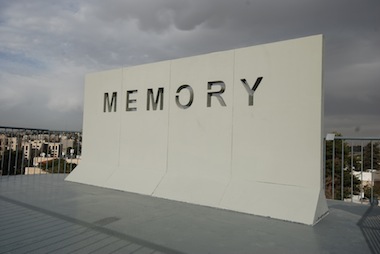
Shilpa Gupta, Memory-II, 2008; cement architectural installation; 331 x 6 x 102.5 in. Courtesy of the Museum on the Seam, Jerusalem.
These more iconic representations of historical trauma find their counterpoint in works like Gilad Ophir’s [Untitled] (2006), a photograph of an unforgiving, stone-stippled slice of the Negev Desert. This image resonates far more with the curator’s desire to reach “the viewer’s sub-conscience [sic] through metaphoric images beyond memory” than do most other works in the exhibition, for the desert floor betrays no trace of the various civilizations that have called the region home over the past 4,000 years.1 Instead, the image becomes a blank canvas onto which the viewer can project the fabled and historic events that have taken place there: Abraham’s expulsion from Egypt, the Roman conquest of the region, centuries of nomadic crossings, and the establishment of contemporary Israeli defense bases. But regardless of their historical import or emotional power, these events all find their terminus in the bleakly delimited horizon, in the casual fact of geological indifference.
Beyond Memory is on view at The Museum on the Seam, in Jerusalem, Israel, through 2012.
________
NOTES:
1. Raphie Etgar, “Curator’s Introduction,” Beyond Memory exhibition, (Museum on the Seam).