
Shotgun Review
CAGE: A New Series of Assemblages and Collages
August 1, 2011Los Angeles-based artist Betye Saar has been carefully crafting assemblages since the 1960s, using flea market and yard sale finds to explore the representation of race and history in pop culture. Her recent exhibition, CAGE: New Assemblages and Collages, features twenty new works that suggest that Saar’s focus has shifted from interrogating visual racism per se to attempting to address a collective refusal to reconcile contemporary inter- and intraracial conflicts with the traumatic histories that produced them.
True to the exhibition title, antique birdcages serve as the foundation for the mixed-media works, composed of stuffed blackbirds that appear to be crows, African-American memorabilia, chunks of coal, and cotton bolls. All of these materials make obvious the references to Jim Crow, as well as the influence of Edgar Allan Poe’s dark romanticism and Maya Angelou’s autobiography I Know Why the Caged Bird Sings (1969). Each cage depicts dark scenes from a past repeatedly buried, exhumed, and reanimated while its complexities remain buried with each unearthing. For example, The Weight of Color (2007) is an assemblage of a patinated household scale topped by a caged crow, which is topped by a small mammy statue. The work’s title might have allowed the viewer to consider the seldom-addressed legacy of colorism within the black community; unfortunately, the scale and the mammy statue fix the reading within nineteenth-century race discourse that binds blackness with servitude. In the collage Nevermore (2010), two crows suspend an antique lace dress in front of a paper tombstone. From the center of the dress emerges a distinctive, fascinating pattern that seems to be a second layer of lace; however, as one takes a closer look, the pattern transforms into rows of black bodies, all in a supine position. An even closer inspection reveals an oft-used illustrated plan for the slave stowage on the infamous slaver, the Brookes. Fascination wanes quickly as the collage turns into the African-American version of “never again,” a familiar refrain among historically traumatized groups.
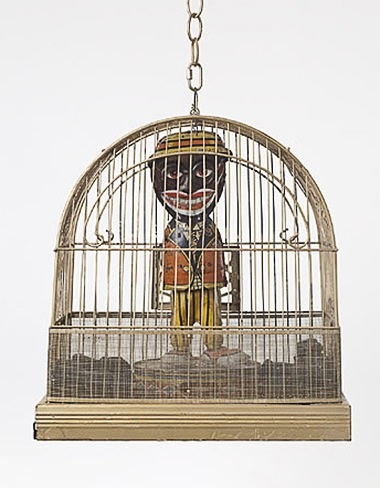
Betye Saar, Rhythm & Blues, 2010; mixed-media assemblage. Courtesy of Michael Rosenfeld Gallery LLC, New York.
This exhibition notwithstanding, Saar’s work continues to stand as an integral element of American culture. Her assemblages and collages not only ensure that certain histories and subjectivities have a stronghold on public memory, but also demonstrate that politics and beauty are not mutually exclusive in contemporary art. However, the beauty of the assemblages in CAGE fails to excavate more than what the audience already knows about the transatlantic slave trade and American apartheid.
CAGE: New Assemblages and Collages is on view at California African American Museum, in Los Angeles, through August 7, 2011.
crystal am nelson is an artist, writer, and designer based in San Francisco. She has contributed to Identity Theory and the African American National Biography, a joint project of the W. E. B. Du Bois Institute for African and African American Research at Harvard University and Oxford University Press, which was published in 2008.