
Shotgun Review
Clandestine Culture
November 15, 2012Walls, light poles, Dumpsters, and other accessible outdoor surfaces and objects have long served as canvases for artists seeking to contribute to the visual pastiche of Miami’s Wynwood Art District. However, as street art’s reception evolves from being considered vandalism to being accepted as an art form within the gallery and museum cabal, some artists’ intentions are also evolving, resulting in an unresolved contradiction.
The first solo exhibition of the anonymous street artist known by the name Clandestine Culture at Gregg Shienbaum Fine Art exemplifies the contextual tension that results from bringing the street inside. Gallery owner Gregg Shienbaum convinced Clandestine Culture to cross the threshold into the commercial gallery space, and the latter’s apprehension is palpable throughout the show, as the work’s rawness is challenged and threatened by the procrustean limitations of market-influenced commodification.
The exhibition opens with Police (2012), Screaming Girl (2012), and The Way the World Sees Us (2012), examples of painted poster works in which black-and-white stencil-like portrait images stand above a red and white banner with the words “Clandestine Culture” written on it: the words are both statement and signature. Through the inclusion of images from conflicts involving riot police and protesters, the graphics highlight and illustrate tension. These posters are the foundation from which the artist departs to experiment with works on wood and canvas as well as with a collaborative installation piece. Street Installation (2012) serves as a physical inversion. It includes an outdoor scene of graffiti-covered walls, barbwire-topped chain-link fence, and the figure of a homeless person lying on a concrete sidewalk. Although its materials are authentic, the work borders perilously on becoming a set piece—an unintended simulacrum of a street scene.
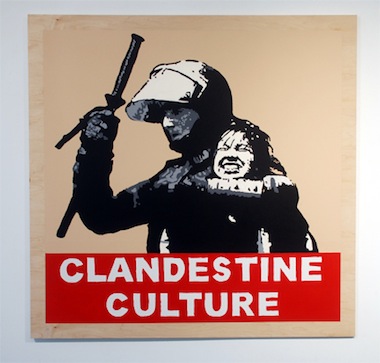
Clandestine Culture, The Way the World See Us, 2012; acrylic on wood, 43 x 43 ½ in. Courtesy of Gregg Shienbaum Fine Art, Miami. Photo: Temisan Okpaku.
The exhibition raises a philosophical issue in relation to street art. Is a work’s authenticity impacted when it transitions from the context of the street to that of the gallery and then enters the market? For purists, the illegality of uncommissioned street art is central to its form and message. The act of raging against the system until the system offers you an invitation strays dangerously close to hypocrisy. But unlike the simple-minded hating that occurs when some street artists begin getting fat checks, the pressing issue is the way context can alter a work’s meaning. There is nothing wrong with getting paid well for one’s work, but does this cause artists to lose touch with the impulse that originally fueled that work? If alienation is the genesis of one’s art, what does acceptance and recognition do to the new work? Entering the syntactical space of a gallery, Clandestine Culture runs the risk of reducing its work in the street to merely an advertisement for the work in the gallery.
Clandestine Culture was on view at Gregg Shienbaum Fine Art, in Miami, from October 13 - November 8, 2012.
Temisan Okpaku is a nomadic artist and writer. After undergraduate study in philosophy at Georgetown University, Harvard University, and the University of Sydney, he continued his interdisciplinary graduate studies at the New School for Social Research, in New York; the University of Southern California; the University of California, Los Angeles; and the San Francisco Art Institute.