
Shotgun Review
DEFEO
September 20, 2011Jay DeFeo is a Bay Area legend who has a huge local following, so it may come as a surprise that it has been fifteen years since her work was shown on the West Coast. Luckily, we will not have to wait so long again, since a retrospective, organized with the Whitney Museum, is scheduled to land at SFMOMA in fall 2012. The current show at Hosfelt is perhaps an amuse-bouche, a precursor to the main event, but the complex and rich experience is not to be missed.
Almost everyone knows, or knows of, The Rose (1958–66), the artist’s legendary work that took her the better part of a decade to produce and had to be craned out of her studio in 1965 before it was even completed. Her tendency to paint and repaint led to the most impressive accumulations that a painter had ever dared; she layered the surface until it became a sculptural mass. Alongside one of her paintings, SFMOMA recently showed some of DeFeo’s photographs, exposing this lesser-known aspect of her production, wherein she built associations through layers of meaning rather than through layers of paint. The current show brings together photographs, drawings, paintings, and a group of very intriguing studies made like low-tech photograms with a copy machine.
The exploration of everyday objects, such as a compass or a tape dispenser, could be a fount of aesthetic discovery in the hands of DeFeo. She imbued everything she touched with a visionary quality that made things into evocative if incomplete symbols. This exhibition demonstrates how she employed a variety of mediums to build a complex constellation of forms. There is a quality to these works that forces a viewer to keep looking and prevents clear resolution. As one bounces from photo to drawing to painting, it is difficult to know which is the study and which is the finished work. If one compares Untitled (White Spica) (1973) to Untitled, 1980 (1980), one sees the same spiraling form, first drawn, then photographed and collaged, then drawn again in another medium. The reciprocity of form and process is profound. The effect is like walking into an artist’s sketchbook and being surrounded by an evolution of imagery.
This is not to say that these works are not powerful on their own. Samurai No. 8 (1987) is as forceful a painting as one
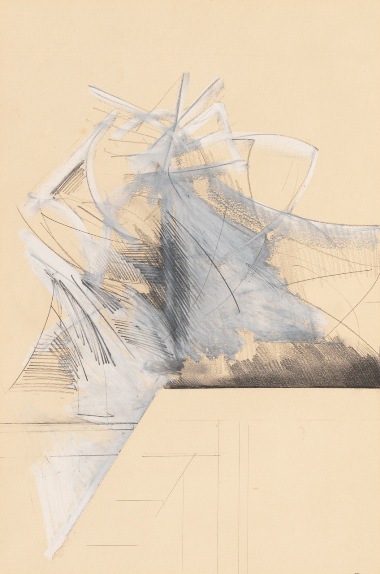
Untitled (Architecture series), 1983; graphite, acrylic and tape on paper; 17 x 14 in. ©2011 The Jay DeFeo Trust/Artists Rights Society/ARS, New York.
could imagine despite the absence of color (the monochrome show is both characteristic of DeFeo’s work and a choice of the curator). Here, the vivid dynamism of Abstract Expressionism finds belated form, but it has not lost anything in a generation. Yet the lesson to be learned in this sensitive and intelligent presentation is that such force does not emerge from the brow or the hand of the artist. This picture arrives as a result of a conscientious development of form over time, passing through multiple mediums on its journey.