
Shotgun Review
Emergency Screening: A Fire in My Belly
January 10, 2011On December 10, the galleries of SF Camerawork filled with an outraged but contemplative public who gathered in response to the removal of late artist David Wojnarowicz’s A Fire in My Belly (1987) from the exhibition Hide/Seek: Difference in Desire in American Portraiture, at the National Portrait Gallery. One of many screenings held recently in reaction, it was prefaced by comments from HIDESEEK.org founders Julia Haas and Alison Maurer, SF Camerawork’s Chuck Mobley, Irene Gustafson, Ian Carter, Kim Anno and Jennifer Sichel, who worked closely with co-curators Jonathan Katz and David Ward on the exhibition. The screening was followed by a Skype discussion with Katz and thoughts from Robert Atkins.
Before the screening, discussion began with a visual presentation by Jennifer Sichel of Hide/Seek’s content—a conscious nod to focus on the whole of the exhibition. The discussion then moved to the controversy over the eleven-second clip of ants crawling over a figure of the crucified Christ—a frustrating topic for many of the featured speakers, who voiced that it was hardly the most provocative imagery in the film. Irene Gustafson spoke to the removal as an example of how homophobia is leveraged under the guise of religion to gain political traction. She cited the intolerant fervor stoked in the service of a specific right-wing agenda, one that blindly re-contextualizes queer expressive energies as ‘hate speech’ against the community.
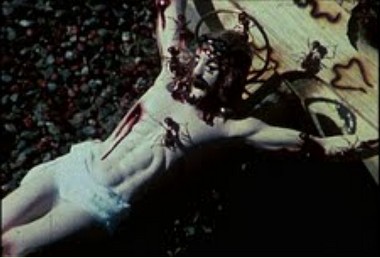
David Wojnarowicz. Film still from A Fire in My Belly, 1987. Courtesy of P.P.O.W and the Estate of David Wojnarowicz.
In the informative Skype discussion with Jonathan Katz that followed, he suggested that the film is both critical and reverent of religion, which imbues it with a haunting, “radical empathy that goes across cultural and economic boundaries.” He also spoke of the removal as paradoxical for a show intended to “dislodge and disrupt” the blacklist against queer content in exhibitions. He called for museums and art spaces not to shy away from exhibitions that take up queer art and culture, for as Robert Atkins asserted, there is nothing inevitable about our social progress. Though the removal is “a blatant hijacking of information,” as Katz noted, it is Wojnarowicz who has had the last word: “the control of information has a crack in its wall.” Screenings like the one at SF Camerawork provide communities with a positive, and productive, opportunity to respond to censorship—and a way to continue to break the “crack in the wall” wide open.
A Fire in My Belly was screened at SF Camerawork, in San Francisco, on December 10, 2010.
Susannah Magers is a master’s candidate in the Curatorial Practice program at California College of the Arts.