
Shotgun Review
From Los Angeles: Eric Baudelaire
September 11, 2010I love the velvety feel of film viewing venues; movie theaters and museum video spaces share the feeling of solace from the bustle of every day life. This was my first reflection after making myself comfortable in a chair opposite a large screen featuring Eric Baudelaire’s work at the Hammer Museum. Sugar Water (2007) deals with media representations of violence as exemplified by the wave of car-bombings that took place three years ago in France.
Sugar Water depicts a fictional metro station called Porte d’Erewhon, alluding to the title of the Samuel Butler novel Erewhon, which explores the hysteria of an imaginary society. A billposter works on a wall poster board surrounded by a decorative golden frame, and the process of pasting separate pieces on the wall slowly reveals the images of the series. During the 72-minute film, a viewer is confronted with images depicting a car bomb explosion photographed a couple of seconds apart. While the billposter works, groups of people walk onto the platform, wait, and then board trains, barely paying attention to the drama unfolding on the wall.
The viewer’s experience is slowed and fragmented as each image is put together piece by piece on the screen, but these same images register only peripherally in each passer-by’s field of vision. The experience is similar to flipping through the channels of television or web portal pages and seeing only a snapshot taken out of the context. The fragmentation, repetition, and detachment of the images cause numbness in the viewing public. The piece however is not merely an illustration of social indifference; it reveals the mechanisms working in both the dissemination of images and their absorption by the public. The distributed images are often fragments of a complex story, which may take longer to unfold.
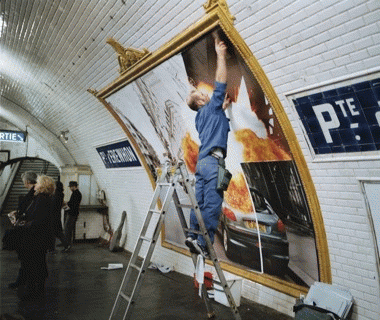
Sugar Water, 2007; HD video, 72min. Courtesy of the Artist, Elizabeth Dee, New York, and the UCLA Hammer Museum, Los Angeles.
Additionally, brief exposure to the visuals gives a viewer insufficient time and information to be fully able to integrate the message.
After leaving my chair at the museum, I learned that Sugar Water was shot on a set, not in an actual train station. My first reaction was disappointment; I had appreciated the artist’s stealth action; its secrecy made possible precisely by the phenomenon on which it was making a comment. It seemed that relaxing in the comfort of a plush chair was a privilege that allowed a view impossible for involuntary participants. Somehow, the piece was richer as a performance, incorporating the psyches and experiences of actual commuters.