
Shotgun Review
From New York: Whitney Biennial 2012
May 31, 2012This year’s Whitney Biennial has so far enjoyed critical acclaim, particularly regarding the exhibition’s meandering curatorial strategy. While this approach is intentional, it has evoked more irritation and confusion than anything. It’s not a good sign when the most overheard phrase is “I don’t get this; is it part of the Biennial?” Where this ambiguous presentation succeeds is where the work itself is dispersed or, in some cases, mines the idea of dispersal and uncertainty.
Lutz Bacher’s The Celestial Handbook (2011) is an absolute delight to happen upon at the Biennial. Peppered throughout the museum—at times placed unassumingly adjacent to works in the galleries and at others hiding in the stairwells or near the bathrooms—each black-and-white image taken from an astronomy textbook is paired with explanatory text. While the description of this work cites that the text “falls short of the immense task” of adequately representing the image, I would offer that the work accomplishes it. Due to its seemingly random placement throughout the Whitney’s five floors, the eighty-five pages give and withhold just enough information to keep them as mysterious as the clusters of stars and heavenly matter pictured on each page. This text/image relationship is not easily deciphered, and this is one of the few examples where the Biennial’s curatorial vagueness is apparent and works.
Robert Gober’s installation Forrest Bess (By Robert Gober) (2012) draws masterfully from the artist-as-curator model. His presentation of the work and life of the outsider artist Forrest Bess is compelling in its quiet reverence and haunting in its thorough telling of Bess’s intriguing life. In what could have been a sensational fulfillment of Bess’s desire to show his self-surgery research and documentation with his paintings—Bess sought to unite his female and male spirits by creating a small opening at the base of his penis—Gober’s treatment delivers an insightful and respectful rumination on the tension between the artist’s private and public lives. Gober’s unification of analogous yet disparate elements, including excerpts from Bess’s diaries that illuminate his process and ideology, Bess’s photographs of his genital self-modification, Bess’s paintings, and Gober’s analyses, engages dispersal by confounding it. By bringing Bess’s gender nonconformity into focus, this approach clarifies Bess’s practice while complicating his identity.
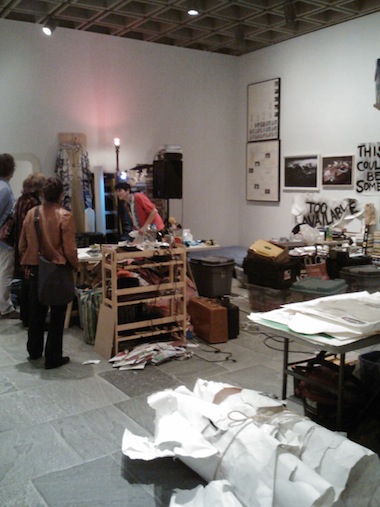
Dawn Kasper. THIS COULD BE SOMETHING IF I LET IT, 2012; performance and installation, Whitney Biennial, 2012. Courtesy of the Artist and the Whitney Museum of American Art. Photo: Susannah Magers.
THIS COULD BE SOMETHING IF I LET IT (2012), the latest incarnation of the L.A.-based performance artist Dawn Kasper’s Nomadic Studio Practice Experiment (ongoing since 2009), could be a fitting title for the whole Biennial. Kasper willingly engages with museum visitors amidst the surrounding static work of the rest of the Biennial. Her studio hums with activity—emitting Bowie refrains, showing old movies, and functioning as a constant site of production—though it’s never quite so obvious where Kasper’s performance begins and ends. Kasper’s work, along with that of Bacher and Gober, encapsulates the best of what this Whitney Biennial has to offer: clever exercises that indulge yet reject uncertainty, jumping out from the nebulously amalgamated whole.
The Whitney Biennial is on view at the Whitney Museum of American Art, in New York, through May 27, 2012, with some programs continuing until June 10, 2012.
Susannah Magers is an independent curator based in San Francisco, currently working on the FOR-SITE Foundation’s exhibition, International Orange. She received her MA in Curatorial Practice from California College of the Arts in 2011.