
Shotgun Review
Geography of Transterritories
May 19, 2010The artists in this show employ a diverse set of approaches to investigating what happens we when bump up against, transcend, and create geopolitical borders. Meanwhile, the curator has dug surreptitious tunnels beneath the boundaries between each work to create a smooth space of debate.
Two stacks of two-by-fours sit on rollers in Michael Arcega’s work Concealarium (2008). They appear to be building supplies in transport, but a small door opens to a human-sized cavity. Like Column, in which Robert Morris used a string (after being injured in rehearsal) to topple an eight-foot tall box, the work is factored on the removal of the body. What has befallen Arcega’s missing person?
Ursula Biemann’s video installation, Sahara Chronicle (2006-2009), documents the transport companies that ferry emigrants across the desert to Europe. Local political and social strife remains unexamined, as Europe looms mythologically out of frame. This unauthorized economy hurtles forward, led by personal desires and conceptions, and a smooth space arises in the inhospitable desert.
In contrast, Carlos Motta’s brilliant interviews ask passers-by in twelve Latin American countries about democracy and US interventions. They reveal both a desire to enforce national boundaries and a resigned acceptance of the corruptibility of the democratic process. Stacked on a child-sized Greek agora, the spacing of the monitors invites viewers to sit in amongst them, creating a secondary enforced participation.
Société Réaliste’s series of posters, Ministère de l’Architecture: Culture States (2008-2009), attempts to undermine the visual means used to centralize power. A map
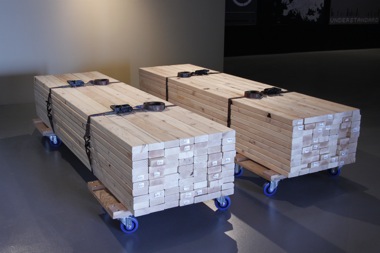
Michael Arcega. Concealarium, 2008; wood, hardware, cotton and mixed media, 20.5 x 90 x 30 in. (each). Courtesy of the Artist.
of political frontiers in Europe from the years 0-2000 CE shows the continent undulating with ‘barriers’. In another, fraught political borders form a new alphabet and a sinister perspective on how these lines arbitrate communication.
As a nod to Felix Gonzalez-Torres, Claire Fontaine distributes a chart of world flags labeled in Arabic. Here the exhibition comes full circle, as the disappearing stack doubles as a figure. Claire Fontaine herself is an identity invented by an artist duo that claims to be her assistants: another person missing at the center.
In Carlos Motta’s newspaper, Stamatina Gregory notes that in democracy, organizations, and associations fill the void left by the individual. This is why I would like to read Michael Arcega’s work as a proposition that the visitor should fill the empty space, where disenfranchisement becomes personal agency and an effective political tool.
"Geography of Transterritories" is on view at Walter and McBean Galleries through May 22, 2010.
Trained at the Rhode Island School of Design and Goldsmiths College, Elysa Lozano’s art practice emulates a not-for-profit, called Autonomous Organization, which has produced proposals for Socialist colonies in a high-rise building in Houston, Texas, re-branded an exhibition space in London as a construction site, and created a web archive of project space survival strategies.