
Shotgun Review
In Case You Missed It: Illusions of Grandeur
September 17, 2011Illusions of Grandeur, at 111 Minna Gallery, showcased the abstract and Surrealist-inspired work of two local painters, NoMe Edonna and Lee Harvey Roswell. Both self-taught, each artist possesses an eye for composition and favors bold colors, as exhibited by the great visual impact of the works on display. Their paintings are also provocative on an intellectual level, employing more familiar and obscure symbolism, inventive and perplexing juxtapositions of elements, and a darkly humorous tone that contrasts with the often-grim themes they explore.
In Edonna’s Blue Room (2009-11), a naked woman braces the sidewall of a stage, as if attempting to hide from both the imagined audience behind the slightly open curtain and the CCTV camera upstage from her. It vividly portrays the vulnerability of the most private self to the aggression of a culture of overexposure. Adding to the menace is the camera, which extends like the head of some prehistoric beast whose body is an amalgam of modern-day grotesques: factories emitting foul eructations; a single rotting arm reaching into a high-end handbag; a reptilian snout bedecked with Mickey Mouse ears and a giant diamond ring; the Washington Monument oozing petrol. Edonna's painting is so effective precisely because of its allegorical pull. It invites viewers to recognize themselves in each of its three “characters”: the monster of detritus, the naked figure trying to escape, and the unseen audience ready to gawk at this spectacle. Blue Room suggests that our culture is haunted by its dependence on the very vices it has created.
Roswell’s work, on the other hand, is sometimes so surreal as to make concise interpretation difficult, perhaps deliberately. One of his most complex pieces, Bacchus Fermentus (2011),
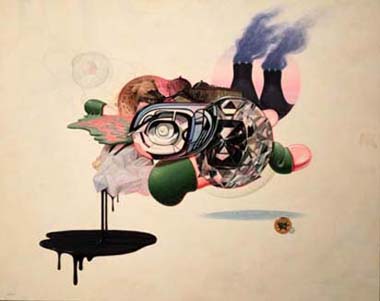
NoMe Edonna. Shelf Life, 2011; acrylic on panel; 16 x 20 in. Courtesy the Artist and 111 Minna Gallery, San Francisco.
is based on Caravaggio’s masterpiece Bacchus (c.1595). While Caravaggio casts a louche teen as his god of wine, Roswell’s Bacchus embodies the mythological figure’s darker aspects as bestower of madness, hallucinations, and epiphanies. The famous drooping lids and unfocused gaze of Caravaggio’s original are here rendered as a series of eyes that progress from realistically aged and swollen organs into more abstract biomorphic versions of themselves. Elsewhere, the painting’s other details—fingers poking out from wood, ghostly forms distorting the objects behind them, tentacles waving—create a febrile atmosphere at odds with the subject’s languid posture. Roswell’s Bacchus, true to his Greco-Roman roots, smiles upon but is not affected himself by the madness that swirls around him. It is up to the viewer to consider whether Roswell’s benediction summons nightmares or ecstasy.