
Shotgun Review
Mark Bradford
May 17, 2012Remnants of handmade posters, layers of billboard paper, grids and swirls of string, and silhouettes of permanent-wave end papers densely layer Mark Bradford’s canvases in his retrospective at the San Francisco Museum of Modern Art (SFMOMA). These materials, the detritus of the street, are the discarded effects of forgotten and overlooked urban spaces. A Los Angeles–based painter and multi-media artist, Bradford maps the topography of social, sexual, and racial economies in his work, creating space for new subjectivities. Bradford’s process of collecting, collaging, and layering images, materials, and meanings create depth and texture, hinting at the glamour of materiality through the oversaturation of signifiers and the density of detail. In his two-dimensional work, Bradford sands and removes his material, employing décollage to expose the hidden stratifications of color and text within the accumulation of ephemera, thus suggesting the depthless multiplicities of cultural meaning.
In Bradford’s video Niagara (2005), Melvin, a local prostitute, saunters down a sidewalk, swinging his arms and hips as he recedes into the distance. The work references Marilyn Monroe’s seductive walk in the 1953 film Niagara as it explores how a black male body inflects that iconic walk and occupies public space. Both Monroe and Melvin assert their sexuality through the embodied walk, implicating the desire of the viewer. The comparison of Monroe to Melvin invites an investigation of the performance of gender and sexual orientation within urban space.
Similarly, in the papier-mâché sculpture of a black basketball, Kobe I Got Your Back (2008), Bradford addresses the
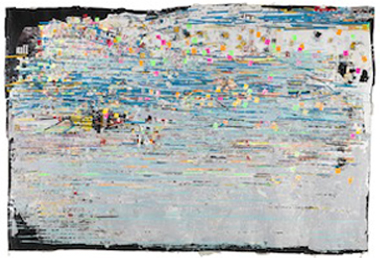
Mark Bradford. Potable Water, 2005; billboard paper, photomechanical reproductions, acrylic gel medium, and additional mixed media; 130 x 196 in. Collection of Hunter Gray.
overdetermined cultural assignment of gender roles to the black body. As the title suggests, Bradford is covering, supporting, and backing the normative stereotype of the black athlete with an other: an unrecognized, unknown, and more nuanced masculinity. By offering Kobe Bryant an opportunity for failure, Bradford acknowledges the instability of an identity as a black male athlete and recognizes the exaggeration of the possibility of a lucrative career in sports while also suggesting an identity outside of athletics through the personal pronoun, I.
In both Niagara and Kobe, Bradford exposes occluded forms of masculinity and offers alternative strategies for self-identification. Though Bradford’s paintings often take the form of abstract maps and grids, mapping urban cartography or the topography of identity, his sculptural and video work is less abstract and more engaged in the performance of identity.
Mark Bradford is on view at San Francisco Museum of Modern Art through June 17, 2012.
Becca Roy is currently pursuing a dual master's degree in Visual and Critical Studies and Curatorial Practice at the California College of the Arts.