
Shotgun Review
Necessary Monsters
August 1, 2011The West Coast premiere of Carla Kihlstedt’s Necessary Monsters, a collaboration with poet Rafael Osés, brings the monsters under your bed to the stage but not to life. The performance, a cycle of songs based on Jorge Luis Borges’ Book of Imaginary Beings (1957), presents nine beasts. Each monster is embodied through either its possession of the female narrator-cum-curator or through the narrator’s interaction with a musician representing the creature.
Over the course of ninety minutes, each monster is released from its box for the duration of a song that reflects upon and symbolizes its characteristics and temperament. We’re first introduced to An Animal Dreamed (Pura Animalis Canticum), a creature that is “as pure as the unuttered word.”1 It wonders at its own song as squealing and rough shrieks mark Rob Reich and Kihlstedt’s delicate piano and violin accompaniment. Possessed by this creature, the narrator variously curls up inside herself and dissects invisible prey, embodying the audience’s most singular and unselfconscious desires.
After being confronted with this “most delicate and glorious of beasts,” the audience meets creatures such as the Nisna (Dimidium Totius), which, being a half, is also a whole, and the One-Eyed Being (Sum Oculus): man at his most pompous, serving as “the light at the end of his own tunnel vision.”2 The arc of this procession moves from the most primitive beings to those that have evolved beyond Homo sapiens. The cycle closes with the Odradek (Domi Stella Aeternum), which represents humanity’s remaining fragments and detritus. It is through this arc that Necessary Monsters comprises a sort of guided self-reflection: in each confrontation, we realize that these creatures, no matter how dark or disturbing, reside within a part of each of us. And each monster is indeed always a little familiar, its monstrosity resulting from the omission or strange combination of physical elements or characteristics.
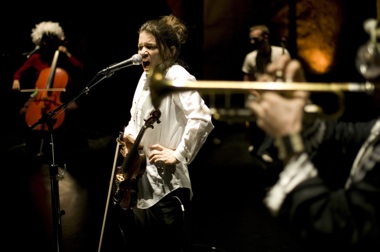
Necessary Monsters, 2011 (still); performance. Courtesy of Yerba Buena Center for the Arts, San Francisco. Photo: Piotr Redlinski.
This work speaks to a long history of field guides compiled through the eyes of writers who look outside their own boundaries and depict creatures that represent the world outside of established knowledge, works such as Herodotus’ Histories, the Chinese Guideways through the Mountains and Seas, and the Alexander Romance. In these guides, the creatures figure as parts of historical or scientific examinations that at one time were looked upon as reliable geographical texts, offering a hidden fiction of monstrosity that inverts the notions of self and Other. In these historical field guides, it’s the subtle veracity of the narrator—the distance and scientific nature of the examination of these creatures—that allows us to find our own strangeness mirrored back and makes these creatures so interesting, useful, and necessary for examining our internal realities and constructing a place for ourselves in the world.
It’s because of these beings, simultaneously credible and mythic, described in earlier types of field guides, that, for all the guidance provided, I didn’t believe in the creatures of Necessary Monsters. Perhaps the telling was too deliberate: we aren’t given the leeway to build these creatures for ourselves and adapt them to our own experiences, and we aren’t able to confront the Squonk (Lacrimacorpus Dissolvens) or the Double (Imago Intus Imago) that may live inside our own minds. Instead, this mythology is already constructed, perfected, and packaged for us, lyrically prescribed and embodied in a sequence of singular movement.
Necessary Monsters was on view at Yerba Buena Center for the Arts, in San Francisco, July 29 and 30, 2011.
Catherine McChrystal is an editor and writer living in San Francisco, serving as an Associate Editor for Art Practical. She received her MA in Comparative Literature from the University of Chicago and holds undergraduate degrees in Classical Civilization and English Literature from the University of Illinois at Chicago.
________
NOTES:
1. Carla Kihlstedt and Rafael Osés. Necessary Monsters Field Guide. 2011.
2. Ibid.