1.4 / Review
Nostalgia/MATRIX 230
December 1, 2009If the devil could be said to reside in the details, then Omer Fast’s Nostalgia (2009) currently on view at the UC Berkeley Art Museum’s MATRIX program, verges on the satanic. And yet the lynchpin of this tripartite video installation—encompassing documentary, reenactment, and full-blown futuristic fantasy—is a fairly simple tale of a trap used to snare small game.
Continuing Fast’s inquiry into the malleability of representation, all three parts of Nostalgia (I-III) are informed by a series of interviews with asylum seekers from West Africa, which the artist conducted in England. Abstracted from this context, the description of the trap, initially related by a refugee from the Niger Delta, is relayed by different characters in increasingly unlikely scenarios. The actual recording forms the soundtrack to Nostalgia I’s brief loop, in which a camouflage-uniformed man sets the trap to the accompaniment of Fast’s questions and Peter X’s responses.
 Omar Fast. Nostalgia II, 2009 (still); two-channel video. Courtesy of the Artist; gb agency, Paris; Postmasters, New York; Arratia, Beer, Berlin.
The anecdote is further fleshed out in Nostalgia II, through actors recreating (and to a certain degree reinterpreting) the interview. We witness the filmmaker’s rather unsavory probing into his subject’s past as a child soldier and his determination to find a “hook,” or story worth telling. To legitimize his process, the filmmaker explains that the interviews will form the basis of two films, one comprising extracts from these conversations and the other dramatizing a single aspect. In the event, both are interwoven in an unsettling projection of the future of political emigration as it may have been envisaged in the ’70s. Filmed on 16 mm to lend an extra hint of authenticity (whatever meaning that bankrupt term may have in this framework) Nostalgia III catapults us into an inverted scenario where English refugees flee their septic isle for the fertile shores of Africa.
Preconceptions are further destabilized by myriad ambiguities within the narrative: the asylum seeker’s story is laced with improbabilities; dinner with a boyfriend is in fact a tryst with a married lover; a father’s bedside story is revealed as a grief-stricken moment of denial. And the overall tension is heightened by moments of gut-churning brutality, such as the inclusion of a giraffe-hunt scene from Chris Marker’s Sans Soleil, or the horrific denouement.
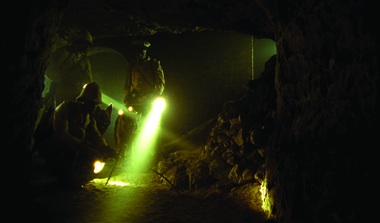 Omar Fast. Nostalgia III, 2009 (still); super 16mm film transferred to HD video. Courtesy of the artist; gb agency, Paris; Postmasters, New York; Arratia, Beer, Berlin.
“Nostalgia” evinces familiar Fast devices—the use of actual events or eyewitness accounts as raw material; mismatched dialogue and action; reenactment; montaged narratives; and seamless editing. His subject material, too, fits into the socio-political and historical trajectory established by his previous works: from the Shoah (Spielberg’s List, 2003); to the Iraq War (The Casting, 2007); and funeral parlors (Looking Pretty for God; After GW, 2008). The format, however, sees Fast breaking out of the confines of a sole element—single, dual, or multi-channel video projection—into a more spatial configuration. If the division is on one level rather literal—each iteration represents a different trope, documentary, reenactment, science fiction—it also emphasizes the distance from factual event (documentary) to fantastical representation (Hollywood).
Fast is as concerned with emphasizing his role as a storyteller (and his reliance on literature rather than film for inspiration) as he is with refuting the categorization of his work as political. The implications of this seemingly disingenuous claim (why choose hardcore political subject matter if this is a purely aesthetic or stylistic exercise?) are mitigated by his use of political issues as foils against which to question the moral status of the image and the sensationalizing impact of mass media. Thus, while Fast’s works may not have an overtly political stance, their narratives are politically angled.
Put most plainly, Fast’s ultimate objective is not to pursue truth, but to emulate, and thereby expose, the machinations through which truth is distorted and concealed. Emerging from the Fast wringer are the recycled images and narratives, arbitrary chronologies, and repurposed facts that the media plays with on a daily basis to create news. Rather than the forensic tools they have become in the hands of artists from Gerard Byrne to Stan Douglas, Fast’s deliberately pastiched restagings make it clear that the resuscitation of history is impossible. Eschewing hollow stylization, he instead acknowledges, plays with, and ultimately critiques currencies of form.
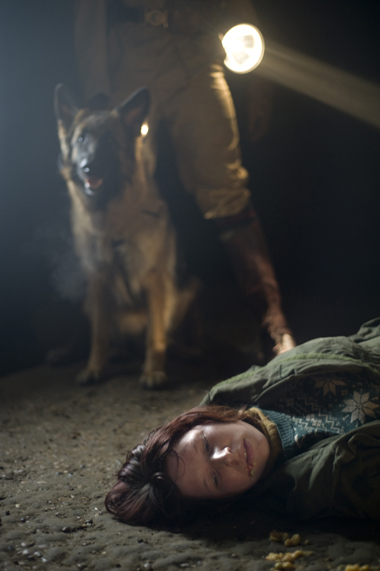 Omar Fast. Nostalgia III, 2009 (production still); super 16mm film transferred to HD video. Courtesy of the artist; gb agency, Paris; Postmasters, New York; Arratia, Beer, Berlin. Photo: Thierry Bal.
The description of the trap is more than a convenient leitmotif, and in the context of this particular subject material its use is, of course, particularly loaded. It represents our vulnerability to managed information, the political games in which people get caught up, and the existential mire of time. And, not least, Fast has previously referred to people as “traps for history.” Here, the subjectivity of our memories, our nostalgia, is also revealed as a trap.
Omer Fast: Nostalgia/MATRIX 230 is on view at the UC Berkeley Art Museum through December 17, 2009.