
Shotgun Review
Oceans and Campfires
February 1, 2012Oceans and Campfires: Allan Sekula and Bruno Serralongue, curated by Hou Hanru, is the first exhibition to bring together the work of Sekula and Serralongue, two prominent contemporary artists who investigate the potentials of documentary film and photography. The similarities between their practices quickly come into focus: both artists are globe-trotters, both challenge mass-media images of the world, both strive to portray human subjects in a non-exploitative way, and both refuse to make overly dramatic images. But even without excess drama and pathos, it’s clear where the artists’ sympathies lie.
The only film in the exhibition, The Forgotten Space (2010) by Sekula and Noël Burch, focuses on the transportation of goods by sea—a fairly unpopular subject in an age infatuated with the concept of immateriality. Consumers of these goods are embedded in a complex network that includes the extremely underpaid workers in manufacturing (and primarily third-world) countries, the people whose homes are lost to expanding ports, and those who labor for the transport system in a deregulated field where precarious conditions and low wages are the norm. For Sekula, the ocean is not an empty or neutral space: it is where the paths of consumption, exploitation, and struggle converge.
Also on view are images of life at sea and the activity of the ports from Sekula’s series Ship of Fools (1999–2010), as well as cabinets with little objects, such as flags, toy ships, and figurines, which are arranged to form scenes of maritime exploitation, as in Docker’s Museum (2010). Nearby are extended quotations from the artist. One poignant example is a story about a crewman who had to paint over the ship’s name during an oceanic passage because the vessel had been sold. Again, Sekula makes clear the links formed between the clean (information exchange and trade) and the dirty (dangerous manual labor).
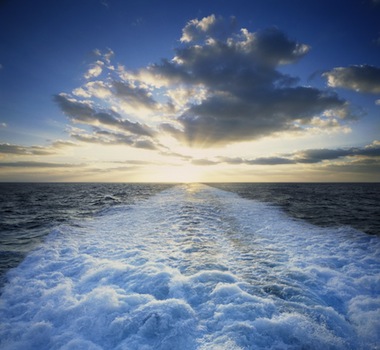
Allan Sekula. Churn, from the series Ship of Fools, 1999–2010; chromogenic print; 48 x 52 in. Courtesy of the Artist; Christopher Grimes Gallery, Santa Monica; and Galerie Michel Rein, Paris.
Bruno Serralongue’s photographs also eschew spectacle in favor of complexity. The artist is interested in struggle and change: his subjects are the workers’ strikes in France (New Fabris, Châtellerault, jeudi 30 juillet 2009, from 2009), the festivities celebrating the newly won independence of South Sudan (Carnival of Independence, 2011), and the aftermath of the formation of the state of Kosovo (Kosovo (ensemble 3), 2010). All of those situations and events have the potential to engender iconic, emotionally charged images, but Serralongue forgoes melodrama in favor of the prosaic. He prefers a down-to-earth perspective on radical events and their consequences, which encourages a connection with the viewer. Overall, Oceans and Campfires is a very timely exhibition. After the tumultuous events of 2011, this exhibition reminds us that politics is entwined with everyday life.
Oceans and Campfires: Allan Sekula and Bruno Serralongue is on view at the Walter & McBean Galleries at San Francisco Art Institute through February 18, 2012.
Julia Glosemeyer is a writer based in San Francisco. She is the art correspondent for the eventseekr blog.