
Shotgun Review
On A Clear Day We Were Lightning
December 2, 2012Brilliant flashes, arching above the ridges and fissures of the brain’s terrain, igniting the swamp of neurotransmitters below; electric sparks, neuronal short-circuits, silent thunder. These are the visions I experienced when I looked into the brain of James Sterling Pitt, as manifested in his works at Eli Ridgway Gallery.
The drawings and sculptures in this solo show constitute an ongoing archive of the artist’s memories. After a 2007 accident resulted in Pitt’s short-term memory deficits, he has maintained a visual diary of everyday events.
Three drawings on display in the current show—Untitled (May 25–July 2, 2012) (2012); Untitled (July 5–October 11, 2012) (2012); and Untitled (August 14–September 16, 2012) (2012)—are examples of such diary recordings. Each measures 30 by 22 inches and contains a grid of smaller drawings that correspond to specific memories. Some images, like a shoe or flowerpot, are easily recognizable. Others are rendered in Pitt’s invented lexicon of symbols. The grids, with their rows and columns of ovoid symbols, recall MRI or CT scan films. Text is also included (“Ribs/ Lightning,” “Expanding and Contracting,” “Seeing through the hands of another’s eyes,” “weaving inside of the brain”).
From these larger drawings, smaller studies emerge, which in turn are the basis for the sculptures. Pitt’s sculptures—made of wood, wire, and acrylic—are an extension of his drawings, and his work has rightly been compared to that of Richard Tuttle. I’ve always associated his sculptures with Calder mobiles, albeit static ones, so I was intrigued to discover the phrase “Frozen Calder” embedded within one of his drawings, Untitled (May 25–July 2, 2012) (2012). There is certainly an element of movement evident in many of the pieces; time appears to have been suspended, as if someone hit the pause button on the flickering memory narrative playing in Pitt’s mind’s eye, which generates tension.
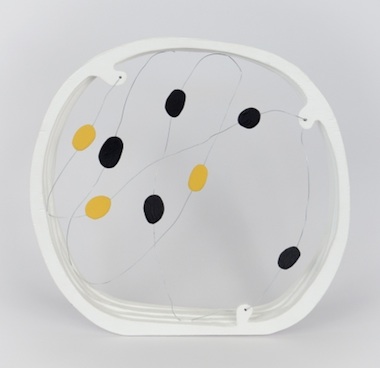
James Sterling Pitt. Untitled ("Lightning Bugs"), 2012; acrylic on wood, wire; 13.25 x 15 x 2.5 inches. Courtesy of the Artist and Eli Ridgway Gallery, San Francisco.
As a physician specializing in the treatment of chronic pain, a purely subjective realm, I am especially interested in the art of James Sterling Pitt. Often I ask a patient, “Tell me where it hurts,” only to have them respond, “Haven’t you looked at my MRI?” In a technologically obsessed culture, we have been conditioned to believe that the subjective experience is less reliable than a high-tech test. Pitt’s art reclaims and asserts the primacy of the subjective. His work is an embodiment of the brain in action, an externalization of the process of memory consolidation. At Eli Ridgway Gallery, surrounded by tokens of Pitt’s memories, I felt as if I were a neuro-archaeologist excavating the strata of his hippocampus.
Pitt shows us that we do not need a functional MRI or PET scan to see the brain at work. Indeed, there are simpler ways of looking and seeing. All that is needed is the hand of an artist.
ON A CLEAR DAY WE WERE LIGHTNING IS ON VIEW AT ELI RIDGWAY GALLERY, IN SAN FRANCISCO, THROUGH DECEMBER 8, 2012.
Colin L. Fernandes is a Bay Area physician, writer, and collector. His writing has appeared in The Indian Express, New York Times, Contra Costa Times, and a Penguin anthology. Dr. Fernandes participated in a panel discussion, “Traumatic Brain Injury, Memory and Creativity: Medical Clinicians Respond To The Work of James Sterling Pitt,” at Eli Ridgway Gallery on November 17, 2012.