
Shotgun Review
From Los Angeles: Para Mi Gente, Los Pintores de Mi Alma
June 11, 2013Primitivism, a Western artistic movement that incorporates imagery from non-Western ethnic groups, has been reimagined in striking ways by the contemporary graffiti-mural artist Marquis Lewis, also known as RETNA. Unlike the works of early Primitivists such as Paul Gauguin, RETNA’s graffiti art quakes the Western canon not by depicting exotic bodies but by closely juxtaposing and sometimes reconfiguring the symbols and morphemes of Western and non-Western languages. In doing so, RETNA seems to access the source code of collective consciousness and of essentialism on a global scale. Arguably, RETNA’s graffiti art also invokes another essential that undergirds humankind: the binary code of computer languages. Earning street cred with graffiti art may never be the same.
RETNA has installed his art at the Museum of Contemporary Art in Los Angeles: a work titled Para Mi Gente, Los Pintores de Mi Alma (“For My People, the Painters of Our Spirit,” 2013). The work is composed of a stunning matrix of graffiti symbols that cross ethnic and cultural boundaries. By its sheer size, the immersive installation persuades the viewer to step inside a performance, which can produce mind-bending results.
A chilling calm settles over a visitor entering RETNA’s extensive environment; one may feel transported from the profane to the sacred, as upon entering a cathedral or ancient pyramid. RETNA’s broad, stick-like markings with their stark, black-and-white forms recall Easter Island figures and conjure a primal yearning for divinity.
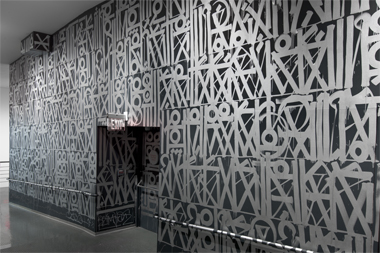
Marquis Lewis, a.k.a. RETNA. Para Mi Gente, Los Pintores de Mi Alma, 2013; enamel, oil, and acrylic on wall; 14.6 x 52 ft; installation view, the Museum of Contemporary Art, Los Angeles. Courtesy of the Museum of Contemporary Art, Los Angeles. Photo: Brian Forrest.
Approaching the marks as remnants of a quasi-ritualistic performance may lead a visitor to search the imaginary script for vestiges of contemporary Western and non-Western languages, particularly East Asian, Hebrew, and Arabic morphemes. Further exploration may illuminate the script’s ones and zeroes, alluding perhaps to binary code. Eventually, the orchestration of all the morphemes and binary code surfacing in the script may crescendo as a psycholinguistic event. Inside RETNA’s environment, one can imagine having digested RETNA’s source code (like Alice in Wonderland 2.0) and having been planted inside humankind’s collective consciousness at this moment in history—when human and computer interactions (via the mobile web) have merged so closely as to make global connectedness seem like an act of breathing.
Para Mi Gente is on view at the Museum of Contemporary Art, in Los Angeles, through August 19, 2013.
Gabe Kaufman is a writer and consultant in San Francisco. He received an MFA from the California College of the Arts.