
Shotgun Review
Rineke Dijkstra: A Retrospective
May 17, 2012The Dutch photographer Rineke Dijkstra’s retrospective exhibition at San Francisco Museum of Modern Art (SFMOMA) is an uncomfortable place. In every room, viewers confront photographs and videos of people of such intimate detail that one can scrutinize their every hair, freckle, and blemish. Exposed to the viewers’ probing gaze, their bodies tower with enormous vulnerability in the large color prints that fill the rooms. As if anticipating the peril of being eternalized on film, they stand so awkwardly and self-consciously that one begins to feel uncomfortable for them.
In Coney Island, N.Y., USA, June 20, 1993 (1993), an adolescent girl holds one hand clenched and the other relaxed. One wonders if the timid look in her eyes reveals the uncertainty about the appearance of her own changing body. In the Olivier series (2000–03), Dijkstra photographed a soldier over the course of three years in the military. A viewer wonders if the stiffening of his posture and brow signify the psychological and physical strain that toughened him through time. One may get close enough to these portraits to study every bit of skin, wardrobe, stance, and expression. To study them in this way is to try to understand Dijkstra’s subjects beyond the bare-fact titles and backgrounds.
One tries to read into the idiosyncrasies of the ears and toes, the striped bathing suits and twisted shoulder straps, the eyes braving the camera and eyes averted. These details are the only clues a viewer has to piece together the missing stories of lives and identities. But one cannot know exactly what stories these traits, mannerisms, and peculiarities reveal. Grouping her subjects together in one extensive exhibition, Dijkstra shows how occupying a human body can be uneasy. She exposes both the explosion of empathic imaginings and the tenacious complexity of understanding others through visual cues.
I See A Woman Crying (Weeping Woman) (2009), a video installed near the end of the exhibition, reflects the overall viewing experience. A group of schoolchildren tell what they
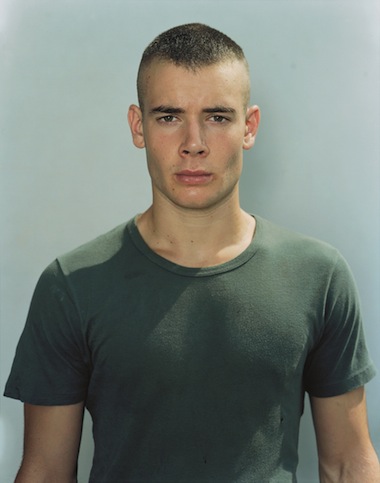
Rineke Dijkstra. Olivier, The French Foreign Legion, Camp Général de Gaulle, Libreville, Gabon, June 2, 2002, 2002; chromogenic print; 49 5/8 x 42 1/8 in. Courtesy the Artist and Marian Goodman Gallery, New York and Paris. © Rineke Dijkstra.
see in Picasso’s painting, Weeping Woman (1937). “I see a woman crying,” one child says. “She is lonely,” says another. “Maybe she is happy, but she is crying.” “She just got a million pound bill and she can’t pay it all.” “No one likes her.” Through the children’s voices, the viewer becomes aware of the similarly imagined conjectures one has been making all along about the subjects of Dijkstra’s portraits. The rich visual details do not help viewers understand the truth about these people but instead keep them rapt before each image, searching for what is unseen.
Rineke Dijkstra: A Retrospective is on view at San Francisco Museum of Modern Art through May 28, 2012.
Jordan Reznick is a San Francisco–based photographer and writer with a strong interest in aesthetic philosophy and political thought. She is currently working on graduate degrees in both Photography (MFA) and Visual and Critical Studies (MA) at California College of the Arts.