
Shotgun Review
The Way Beyond Art: Infinite Screens
March 23, 2013According to the wall text written by Werner Herzog, his installation Hearsay of the Soul (2012) is a showcase of still images of etchings and paintings created about 1630 by the Dutch artist Hercules Segers, “the father of modernity in art.” Indeed, the title and wall text suggest a human experience that is bound to the natural landscape and to the modernist, masculine, and Eurocentric traditions in visual art and music. Herzog asserts, “Segers’ images are hearsay of the soul,” and paired with Ernst Reijseger’s music, these “ecstasies morph into each other.”1
The twenty-minute, five-channel video slideshow is projected onto three walls in a conventional gallery and is composed of Segers’s etchings and drawings of mostly desolate, terrestrial landscapes. The palette is minimal, primarily light sepia and bluish-grey hues. The framing and order of the slides and alternating video footage seem haphazard and arbitrary.
The sound accompanying the images begins with humming and chanting and shifts to cello music composed and performed by Reijseger. As viewers watch the cellist perform, they become witnesses to the ecstasy of his performance. Reijseger’s face contorts with the sound of his instrument and with the physical engagement of his body; clearly he is transformed.
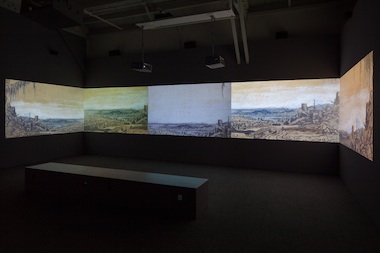
Werner Herzog. Hearsay of the Soul, 2012; five-channel video installation. Courtesy of the CCA Wattis Institute for Contemporary Arts, San Francisco. Photo: Johnna Arnold.
The sound shifts then to operatic vocals and music. While the incorporation of humming and chanting vocals at the beginning of the piece offers an exception to the Western musical tradition, their early placement might also simply reinforce the modernist idea of linear progress, wherein opera exists at the final and most developed stage of civilization. With its notions of universality and progress, modernism allows the ideologies of a small elite to stand in for the ideologies, desires, and aesthetics of all. And through its focus on two very specific artists bound to a fairly narrow creative tradition, Hearsay of the Soul presents a too narrow and essentialized view of the human experience.
Hearsay of the Soul is on view at the CCA Wattis Institute for Contemporary Arts, in San Francisco, through March 30.
Diana Stapleton is a experimental video and performance artist living in San Francisco. She is currently pursuing an MFA and an MA in Visual and Critical Studies from the California College of the Arts. She holds a BFA from the University of Arizona in new genres and printmaking.
________
NOTES: