
Shotgun Review
From New York: Toxic Beauty: the Art of Frank Moore
December 5, 2012PAINTING THE PLAGUE: Beauty as Activism
To Frank Moore (1953–2002)
________
Often when we look at images we don't want to see, we don't see them. In the case of the exhibition Toxic Beauty: the Art of Frank Moore, thirty-five paintings and more than fifty gouaches, prints, and drawings challenge and seduce viewers with their complex surfaces, reminding us that a painting is first and foremost an object of contemplation. These intricate, large-scale, allegorical paintings, which are often enhanced with photo-silkscreened images and whimsical customized frames, ask to be deciphered and read like epic texts.
While creating wonder, as do works by Hieronymus Bosch or Fred Tomaselli, Moore's paintings also tell us the stories of AIDS both as a personal archeology and as a social and medical pandemic. Formal aspects of Moore's work extend the content, cutting through representational hierarchies and conventions with a particular magical realism that speaks to the same impulses that guided the artist in his political activities. Born in New York City, Moore was educated at Yale and participated in the New York art scene of the '80s and '90s while he was infected with AIDS.
In Arena (1992), every element in the painting has a direct link to Moore's life. As a nonlinear labyrinthine autobiography, it is composed of visual hubs or ex-votos: at the center, Moore's lover lies dying; human skeletons carry banners with Latin mottos—"We Are Shadows and Dust," "Birth is the Beginning of Dying"—while the Buddha and Moore's friends from the legendary activist art collective Act Up meditate in a clash of body and culture. Moore telescopes us back in time and the history of painting while describing the fate of his life and community.
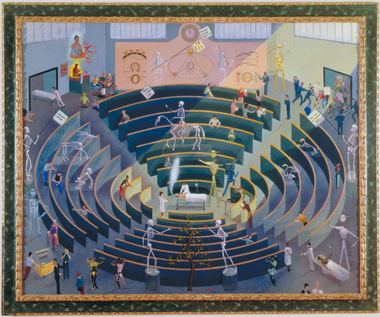
Frank Moore. Arena, 1992; oil and silkscreen on canvas mounted on wood, in antique gilded frame; 61 x 72 in. Collection of Gian Enzo Sperone, Sent, Switzerland. Courtesy of Sperone Westwater, New York.
As we begin to historicize AIDS and the visual culture that surrounded it, Moore's prescient and powerful body of work is central and critical. Invested as both a patient and an activist, Moore participated in the creation of the iconic red ribbon and was a member of the group Visual AIDS. He grafted his activism onto an already developed politics of deep ecology and gay culture with such a refined and transformative visual vocabulary that paintings such as Pearline (1991) and Freedom to Share (1994) have become classics in the canon of twentieth-century art.
For artists, curators, and activists today, Moore's themes of an endangered environment, an ailing healthcare industry, genetically modified foods, and gay rights are still at the forefront of representation and concern. They are as pertinent as ever. If toxic beauty were an aesthetic condition, it would be my hope that we could all experience the triumph of beauty over the toxic through this exhibition. Moore would have wanted that.
Toxic Beauty: The Art of Frank Moore is on view at New York University's Grey Art Gallery and Fales Library, in New York, through December 8.
Natasha Boas, PhD is a San Francisco–based independent curator, writer, and professor of contemporary art. She has been curating internationally for over twenty years and has contributed to numerous publications and catalogues. She has taught at California College of the Arts, San Francisco Art Institute, Stanford University, and Yale University, and her most recent exhibitions include We They, We They: Clare Rojas, Only Birds Sing the Music of this World with Harrell Fletcher, and E is for Everyone: Celebrating Sister Corita. Boas’ essay “Was There Ever Really a Mission School: A Partial and Incomplete Oral History” is published in the current University of California Berkeley Art Museum Barry McGee retrospective catalogue. She is a regular contributor to The Believer.