
Shotgun Review
From Miami: Trading Places II
September 24, 2012In 2005 the Museum of Contemporary Art, North Miami (MOCA) launched Trading Places, an experimental program to support emerging South Florida artists at points in their careers when major institutional support will help them advance their practices. Artists use the museum’s galleries as public studios for two months, researching and developing new projects rather than working towards a culminating exhibition. They also receive materials, curatorial guidance, and technical assistance. In exchange, they mentor teens and young adults enrolled in MOCA’s free afterschool programs.
On September 14, 2012, MOCA introduced the program’s second iteration, Trading Places II, with Dona Altemus, Onajide Shabaka, Magnus Sigurdarson, Rick Ulysse, and Antonia Wright. The group represents an eclectic range of forms and interests, from Shabaka’s use of traditional silhouettes and textiles to examine Black Atlantic mythologies about Southern landscapes, to Sigurdarson’s installation-driven quest for melancholia in Miami. Since Friday, September 14, was the artists’ first day in situ, the experiment’s final outcome remains to be seen, but the early works and sketches on view during the opening day were promising.
The poet and photographer Antonia Wright is one to watch. Prolific in her practice, she had a number of polished works installed, including Deep Water Horizon (2011), a looped video of her porcelain-white nude body rolling down a filthy South Beach alley. Made in response to the 2010 BP oil spill in the
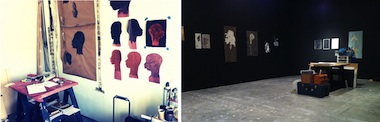
Left: Artist Onajide Shabaka’s current home studio space. Image courtesy of Museum of Contemporary Art, North Miami (MOCA). Right: Artist Onajide Shabaka’s temporary studio at MOCA. Image courtesy of Onajide Shabaka.
Gulf of Mexico, the video creates a visceral response, matching the reaction one might have had while watching footage of the disaster. Wright is unafraid to go to extremes for her work and undoubtedly will take advantage of MOCA’s resources. In contrast, Dona Altemus is still honing her visual vocabulary. The youngest of the group and a very recent BFA recipient, she trained as a painter, and a Google search of her name produces an online graphic-design portfolio. For Trading Places II, Altemus plans to investigate installation, but there was little indication of her approach in her near-empty studio. Altemus’s wildly diverging paths are a concern to her success here, and her readiness for this program remains to be seen.
A unique incubator for thinking and making, Trading Places reflects the experimental underpinnings of Miami’s burgeoning art scene. Through the program, MOCA reaffirms its dedication to local artists and its commitment to repositioning Miami as a national leader in the arts. By shifting the focus from product to production, MOCA shows that, while it may look like and often is play, art making is hard work and serious business.
Trading Places II is on view at the Museum of Contemporary Art, North Miami through November 11, 2012.
_____