
2.9 / Review
Yoshua Okón: 2007-2010
January 10, 2011If sculpture has taken over more and more of its surroundings—from the plinth (Brancusi) to the edges of a room (Serra) to entire museums (Haacke)—then groups of people that have been incorporated into social practice could, by extension, be considered humans-as-material. The dynamic between social progressiveness and objectification is embodied on one end of the spectrum by the performative exploitations of artists like Santiago Sierra; on the other, it is represented by the community service projects championed by Grant Kester.1 Defying this simplistic duality, Yoshua Okón’s videos advocate a communitarian position by brazenly exploiting their participants. He achieves this by maintaining an authorial ambiguity that allows for an open-ended dialogue with his audience.
For the Bocanegra series (2005–2007), Okón collaborated with a group of Third Reich enthusiasts in Mexico. Bocanegra: A Walk In the Park is installed on hanging monitors that encircle the viewer. As each monitor comes to life, the group on-screen goose-steps through a square in full regalia. In Bocanegra: The Gathering, the members of this club—surrounded by Nazi memorabilia and again dressed in uniforms—smoke and drink, swear loyalty, sing songs, and confide directly to the camera, explaining their attraction to Nazism, saying, “People like order but sometimes they’re outside the order,” or “What attracts me are the symbols, not the ideology.” It’s unclear whether these collaborators are aware of the irony of their actions or even of their own subjectification. Through his editing, Okón stays mum. Without a docu-narrative, the audience is left to their own devices to make assessments or pass judgment, both on the actors (how dreadful!) or on the artist (is he using them?), thus engaging in the same processes of self-aggrandizement and vilification of the other that made Nazi projects possible.
Bocanegra: The Salute is a less captivating gesture. In a series of mini-monitors leaning against a side wall, the uniformed enthusiasts are portrayed alone against the backdrop of a giant Nazi flag, clicking their heels and saluting. The use of abrupt editing and fast motion lends the work a physical slapstick that undermines the challenge created by ambiguity.
In other, more incisive meditations on the medium, Okón’s work indicates precisely how the viewer is divorced from humanistic considerations by the camera work, the editing, the monitor, or the installation. This exteriorization is dramatized by the dissonance between the work Hipnostasis (2009) and its explanation. According to the artist, “old hippies and beach bums” are “faithful to their non-materialistic ideology, forming a tightly-knit alternative community that…thrives and survives on its own terms."2 From this description, a viewer might expect a work that, as Clare Bishop describes, “rehumanizes … a society … fragmented by the repressive instrumentality.”3 Yet the men are filmed perched on rocks by the ocean in the manner of animals in a nature show. Their distracted postures while they chew pieces of food or scratch their heads make them seem disengaged, living in their own world. An explorative close-up captures a man’s eyes but not his gaze. None of the men speak. Instead, the artist and Raymond Pettibon have scrawled terms across the wooden frame that encases the monitors: Swami X, Morpheum, and Synanon Snon.4 The presentation of this alternative “reality,” as the artists go so far as to call it, prevents any penetrating understanding of either the community or its constituents. It suggests that a passive audience, by mistaking documentary-style film for a revelatory understanding, participates actively in its subjectification.
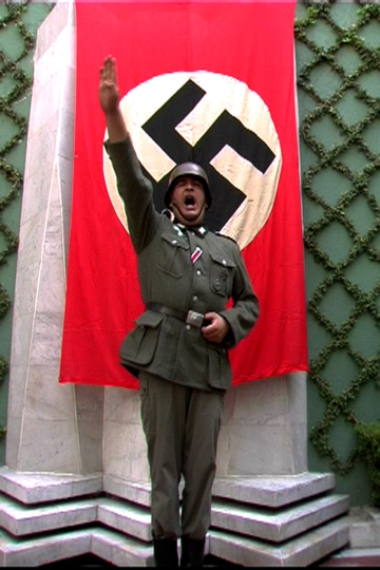
Bocanegra: The Salute, 2010; video still. Courtesy of the Artist and Yerba Buena Center for the Arts, San Francisco.
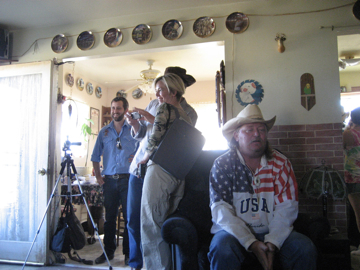
White Russians, 2010; video still. Courtesy of the Artist and Yerba Buena Center for the Arts, San Francisco.
For Hausmeister (2008), a small monitor is installed along the floor near the corner in a dark room. It plays a video of a gallery guard who opens a small door in the bottom of a wall and crawls through it on his hands and knees. Gesturing toward the camera, he alternately mumbles and growls incoherent bits of speech and flings his hands. At one point he seems to be gesturing for the visitors to leave. This caricature of the relationship between gallery guards and gallery-goers invades the Yerba Buena. In this voluminous space where people have come to look, the guards themselves appear as if on display. Yet in the avoidance of staring obtrusively at another human, they often go unacknowledged. This jarring shift from cerebral reflection to environmental awareness underlines a discomforting dynamic that the visitor is in the process of creating. This raises the question of how Okón defines the art-going audience he has implicated. He is equitable in his unsparing portrayal.
For White Russians (2008), the stage is set in the modest home of the Akien family, who, along with friends, perform a series of loosely scripted actions for the benefit of an art-viewing audience who filter in and out of their living room. The family sings Western songs, watches football, and erupts in spontaneous screams as the curious trickle in, somewhat self-consciously, sip White Russians (served by the family), greet each other, and stare unabashedly at the scenes unfolding.
The proceedings are filmed on four cameras placed at different angles along the perimeter of the room, facing its center. Four monitors playing each perspective are mounted in the center of each wall of the exhibition room. Bench seats are installed in the corners, and since the videos play intermittently on the various screens, these fixed positions don’t allow a full view or even a straight-on one. The spectators in the video are an uncanny version of the Yerba Buena audience: caught in the middle of the drama, yet positioned far enough outside it not to get involved, they mirror our own spectatorship. At one point, a host kicks everyone out: spectatorship itself seems to be in the hot seat.
Another way to objectify is through the use of humor, which runs like an inconspicuous hook and line through each of these works. In Canned Laughter (2009), a series of projections show actual maquiladora workers as they produce the titular product. In front of the projections, trestle tables shelve monitors playing an advertisement for the company’s product. Stacked about are the cans of laughter printed with a quote by Henri Bergson: “Our laugh is always the laugh of others."
What seems at first glance to be a glib statement about the manufacture of acceptance of a despotic capitalist regime seems upon closer inspection to perfunctorily identify (through its corny humor) the problematic sphere of mediation that the artist inhabits. To work with groups is to objectify them through an outstanding difference, and as Bergson also says, it is “the ABSENCE OF FEELING which usually accompanies laughter."5
Returning to the Nazi enthusiasts, the final part of the Bocanegra series is The Movie, which is written, directed, and acted in by the group member Manolo. The film becomes a self-parody when Manolo laments, “Ahhh! I’ve just ejaculated on it,” meaning that he’s become so sexually excited that he has soiled his beloved Nazi cap. Self-parody implies a level of reflection and sophistication that requires one to acknowledge his or her own failings. However, if “our laugh is always the laugh of others,” it also implies a level of intended homogenization with the future audience of the movie and certain presumptions about what their perception of Nazi enthusiasts might be.
To circumvent the trap of presumption-based judgments, the artist takes up Jacques Ranciere’s idea of emancipating the spectator by “blurring of the opposition between those who look and those who act,” which transforms “spectatorship into activity by turning representation into presence.”6 By relinquishing his vocalization of meaning, every aspect of Okón’s works become performative and subject to interpretation. If this work is successful, audience members will challenge themselves to reach around the artist to relate with his subjects. In the midst of objectification and assumption, actual social progressiveness transpires.
Yoshua Okón: 2007-2010 is on view at Yerba Buena Center for the Arts, in San Francisco, through February 6, 2011.
________
NOTES:
1. Mick Wilson, “Autonomy, Agonism, and Activist Art: An Interview with Grant Kester. Art Journal, Sept. 22, 2007.
2. http://www.yoshuaokon.com/ing/works/hipnostasis/text.html
3. Claire Bishop, “The Social Turn: Collaboration and its Discontents.”Artforum, Feb. 1. 2006.
4. http://en.wikipedia.org/wiki/Swami_X; http://en.wikipedia.org/wiki/Morpheus_(mythology); http://en.wikipedia.org/wiki/Synanon
5. Henri Bergson, “Laughter: An Essay on the Meaning of Comic", http://www.authorama.com/laughter-2.html
6. Jacques Ranciere, “The Emancipated Spectator” Artforum, March, 2007, http://findarticles.com/p/articles/mi_m0268/is_7_45/ai_n24354915/pg_10/?tag=content;col1l